
Contents
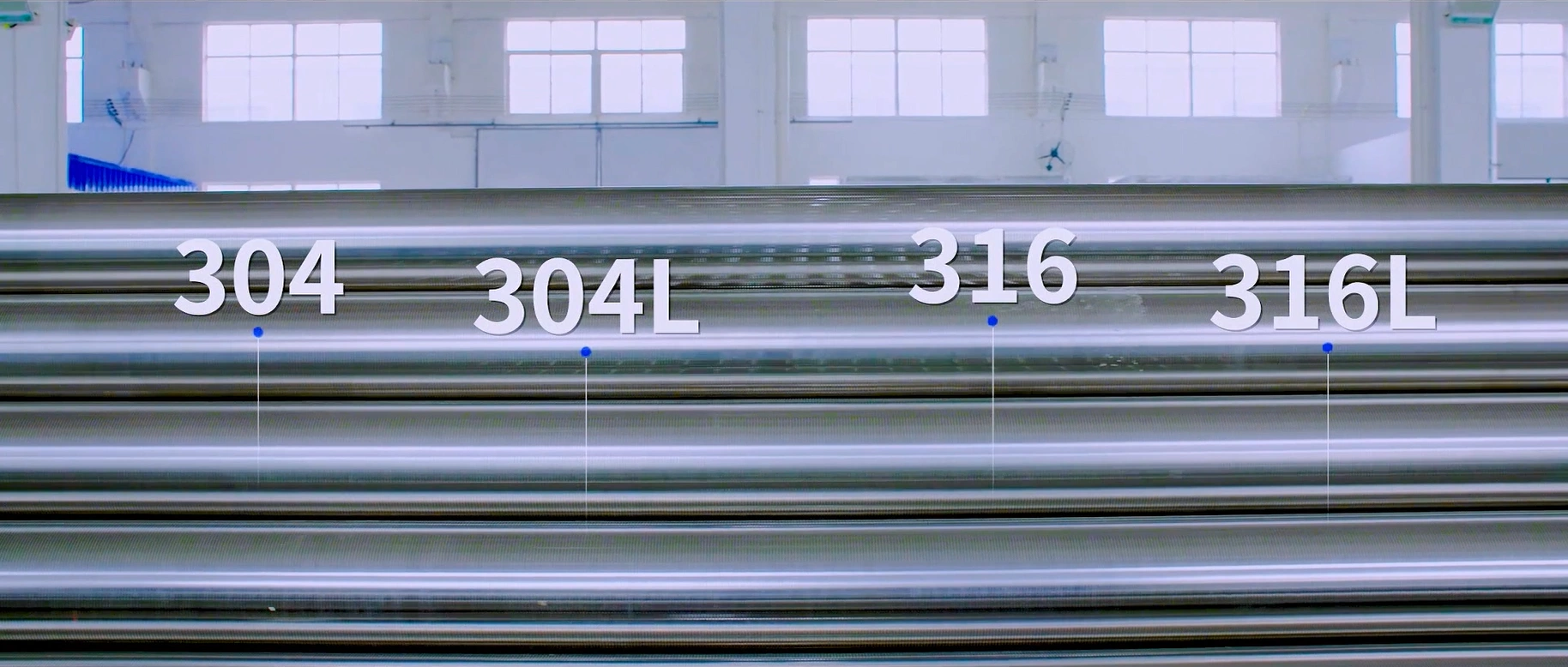
The choice between 304 and 316 stainless steel well screens should begin with the water and service conditions. Grade 316 contains molybdenum, which supports improved corrosion resistance in relevant environments. That advantage does not make every 316 screen suitable for every groundwater chemistry. The low-carbon variants, 304L and 316L, introduce a separate consideration associated with welding and resistance to intergranular corrosion. [1][2]
A useful specification identifies the exact grade, the components it applies to and the evidence required to confirm the supplied material.
Separate the alloy question from the welding question
“304 or 316?” and “standard carbon or low carbon?” are related questions, but they are not interchangeable.
| Grade family | Main distinction to discuss | Purchasing question |
|---|---|---|
| 304 / 304L | Chromium-nickel stainless family; the L grade has lower carbon | Which exact grade and product standard does the design require? |
| 316 / 316L | Molybdenum-bearing stainless family; the L grade has lower carbon | Does the selected alloy suit the water and fabrication conditions? |
Material producers distinguish these grades by composition and fabrication considerations. A low-carbon designation should not be interpreted as a universal ranking of strength, service life or resistance to every form of corrosion. [1][2]
If the design specifies a particular grade, do not replace it with a vaguely described “equivalent stainless” on the purchase order. Ask the designer to approve any proposed alternative against the applicable standard and service conditions.
Give the material reviewer a water analysis
Location alone is not a water-quality specification. Two wells in the same region may expose materials to different conditions. The review should consider the available water chemistry, service temperature and the operating environment. The well's anticipated cleaning and rehabilitation treatments also deserve attention. [2][3]
As a practical enquiry package, include the dated water-analysis report and identify the sampling location. Highlight chloride, pH and other constituents identified by the project engineer as relevant. Explain whether the report represents the intended producing interval or only an early exploratory sample.
Do not select a grade from a universal chloride cutoff copied from an unrelated application. Temperature, deposits, local conditions and fabrication details can change the assessment. Where the water data are incomplete, record the uncertainty instead of converting a provisional assumption into a confirmed specification. [2][3]
Specify the whole assembly
The words “316 screen” can leave important questions unanswered. Does the requirement cover the profile wire, support rods, end fittings, casing connections and any supplied accessories? Does the certificate correspond to each relevant material lot?
An assembly-level material schedule gives the supplier a clear basis for quotation. It also makes exceptions visible. If a connection or accessory uses a different material, the difference can be reviewed before manufacture rather than discovered during inspection.
Ask for the grade designation and applicable product standard in the same schedule. If dual certification is offered, request the actual certification rather than assuming that a commercial description proves compliance with both grades.
Make traceability part of the purchase order
Material identification is useful only when it can be connected to the delivered parts. Agree the required records before production: material certificates, heat or lot identification, the drawing revision and any project-specific inspection documents.
Where positive material identification is requested, define its scope and the information it is intended to establish. It should not be treated as a substitute for all mechanical, dimensional or fabrication checks. The acceptance package should answer the project's actual questions rather than merely accumulate certificates.
For a welded assembly, also clarify the required fabrication and inspection documentation. Keep these requirements distinct from a supplier's general management-system certification; they describe different kinds of evidence.
Compare the specified assemblies commercially
Ask for a price comparison only after the technical alternatives have been defined. Keep diameter, active length, slot width, connections and inspection scope consistent. Otherwise, a difference attributed to stainless grade may partly reflect a different screen construction or delivery scope.
OFD's water well solutions provide the starting point for a screen enquiry. Send the material schedule, water analysis and drawing to OFD, marking any proposed alternatives for review. For the remaining order details, refer to the well screen and casing RFQ guide.
References
[1] Outokumpu, Core range, including 304 and 304L grade descriptions. Source
[2] Outokumpu, Supra range, including 316 and 316L grade descriptions. Source
[3] Roscoe Moss Company, A Guide to Water Well Casing and Screen Selection. Source