
Contents
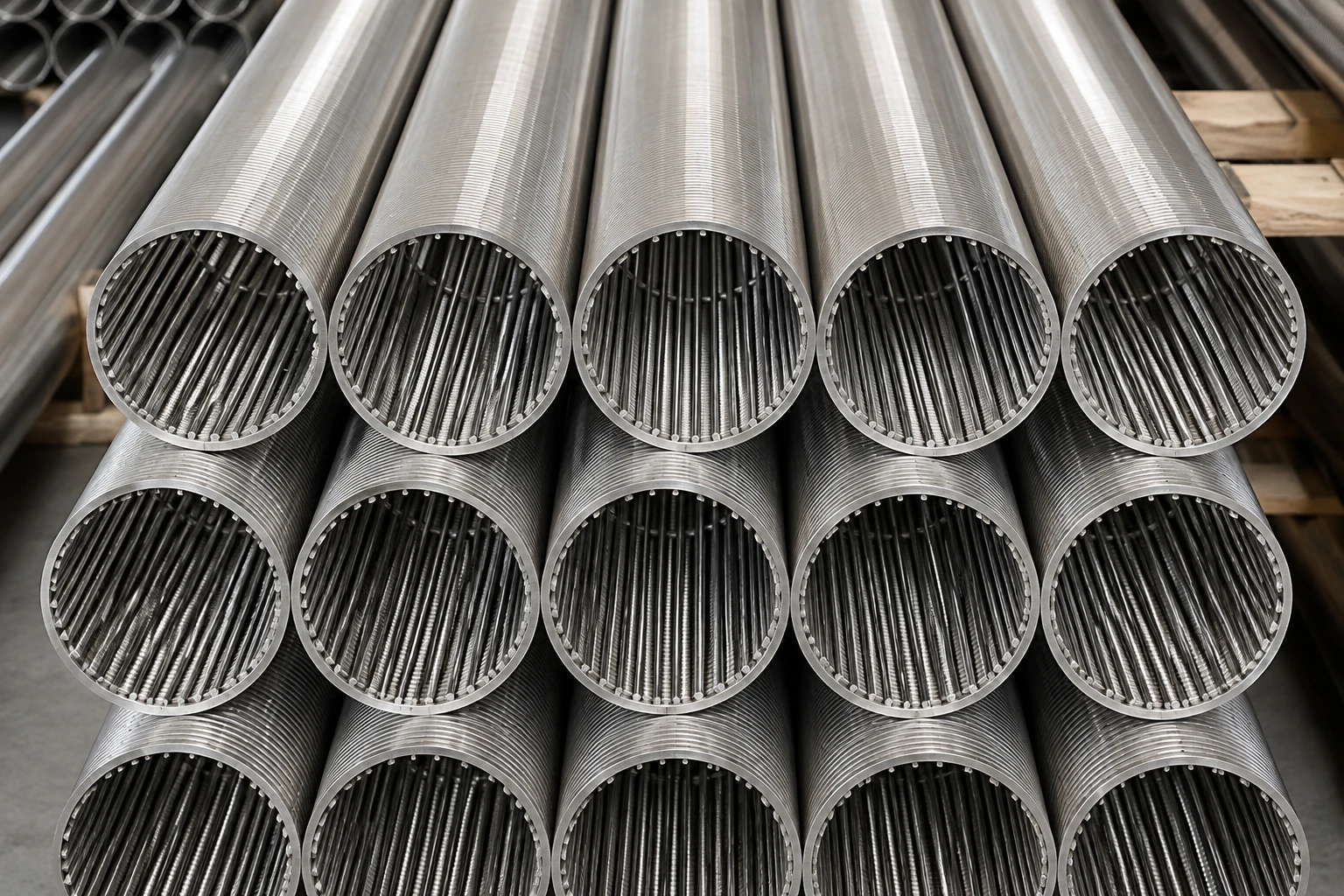
A wire-wrapped well screen and a slotted pipe can both admit groundwater into a well, but their construction differs. A continuous-slot screen uses profiled wire supported by longitudinal rods. A slotted pipe has openings cut into a pipe wall. Choosing between them requires a review of the well design, opening dimensions, structural requirements and construction method—not simply a comparison of price per metre. [1][2]
For procurement, the useful question is: which proposed assembly meets the same hydraulic and mechanical requirements, with evidence the project team can check?
Start with the opening geometry
In a typical continuous-slot screen, the narrow opening is at the outside and widens inward. This geometry can help particles pass through the opening after entering it. It does not make the screen immune to mineral scale, biological deposits or poorly selected filter material. Slotted pipe geometry depends on how the openings are made; buyers should request the actual slot profile rather than infer it from a product name. [1][2]
Specify the required opening width, tolerance and measurement method for either design. A quotation that states only “fine slot” leaves the supplier and the installer working with different assumptions.
Compare area on the same basis
Ask each supplier to identify the active screen length, outside diameter and calculated open area of the offered construction. Distinguish the length containing openings from the overall assembly length, which may include blank ends and connections.
Two products with the same nominal diameter and slot width need not have the same open area. Wire dimensions, support rods and the number and arrangement of cut slots affect the comparison. More open area alone also does not establish a well's sustainable pumping rate; aquifer conditions and the completed well matter. [1][3]
A practical bid comparison should therefore request both the area calculation and its assumptions. The engineer can then assess the proposed screen within the complete well design.
Review strength separately from hydraulic performance
A high open-area percentage is not a structural rating. Similarly, a thicker pipe wall does not, by itself, prove that a completed slotted assembly is suitable for a specified installation depth. Screen configuration, materials, connections and loading conditions all need to be considered. [2][3]
Ask the supplier to identify what its mechanical documentation covers: the screen body, the connection or the complete assembly. A tensile test and a collapse assessment answer different questions. Do not substitute one for the other when reviewing an offer.
The comparison sheet can be kept short:
| Item | Information to request from both suppliers |
|---|---|
| Retention requirement | Approved formation or gravel-pack design and slot specification |
| Hydraulic geometry | Active length, actual diameter and open-area calculation |
| Mechanical design | Relevant loading assumptions and assembly configuration |
| Connection | Drawing, dimensions, joining method and inspection scope |
| Construction access | Clear internal dimensions and proposed development tools |
| Acceptance | Agreed dimensional checks, records and traceability |
Include installation and future maintenance
Screen selection should be coordinated with the contractor's installation and development plan. Internal support geometry, connection transitions and clearances may affect the tools that can pass through or operate inside the assembly. Manufacturers describe different development approaches for different screen constructions, so a method suitable for one configuration should not be assumed suitable for all. [1][2]
Before an order is placed, ask the contractor to review the proposed drawing. Record any restrictions on lifting, handling and tool access in the purchase specification. This is also the time to resolve whether accessories are included in the quoted supply or ordered separately.
Put the design requirement ahead of the product label
For an artificially gravel-packed well, the formation, pack and screen must work together. For a naturally developed well, the screen selection follows a different design route. Neither a familiar trade name nor a neighbouring well's specification replaces this distinction. [3]
If slot selection is still open, use OFD's well screen slot-size guide to organise the required information before comparing commercial offers. Where the design is already approved, send the same revision to every bidder so price differences can be traced to actual scope differences.
OFD's water well product range includes stainless steel wire-wrapped screens and related completion components. To discuss a screen requirement, send OFD the approved drawing and specification, including the connection, active length, slot tolerance and inspection requirements. Identify any alternative construction that the designer is willing to evaluate.
References
[1] Johnson Screens, Stainless Steel Water Well Screens and Accessories. Source
[2] Roscoe Moss Company, A Guide to Water Well Casing and Screen Selection. Source
[3] USDA NRCS, National Engineering Handbook, Part 650, Chapter 12: Springs and Wells, February 2021. Source